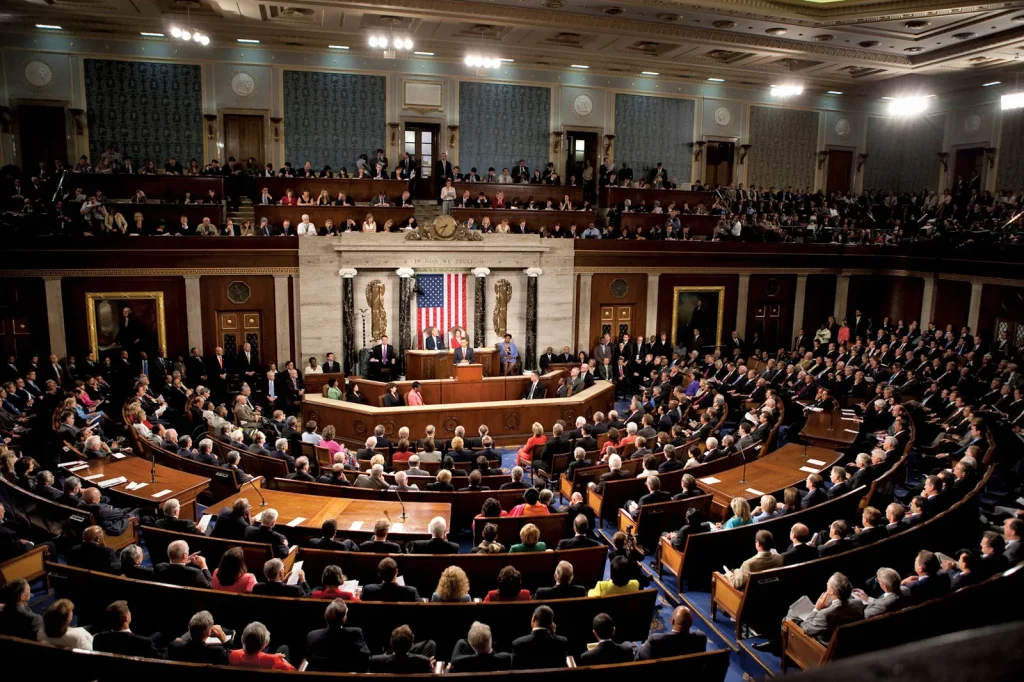
The Republican-led House has approved a major bill that seeks to formalize a national definition of antisemitism and guide how federal anti-discrimination laws apply to schools. The vote comes after months of heated demonstrations linked to the Israel–Hamas conflict that spread across college campuses.
Lawmakers passed the proposal with a 320-91 vote, gaining support from both parties. The measure would write the International Holocaust Remembrance Alliance (IHRA) definition of antisemitism into Title VI of the Civil Rights Act of 1964. The legislation now heads to the Senate, where its future remains unclear.
What the Bill Would Do
The bill, introduced by Rep. Mike Lawler (R-NY), adopts the IHRA’s working definition, which describes antisemitism as “a certain perception of Jews, which may be expressed as hatred toward Jews.”
The definition covers actions aimed at Jewish or non-Jewish individuals, their property, Jewish community institutions, or places of worship.
Lawler’s office said the bill requires the Department of Education to use the IHRA definition when enforcing federal civil rights laws. The office argued that this step helps schools identify antisemitic incidents faster and ensures proper investigations.
Stefanik Praises the Measure
House GOP Conference Chair Elise Stefanik strongly supported the bill. She wrote on X that the proposal strengthens protections for Jewish students and aligns with a Trump-era executive order on antisemitism.
She said the legislation sends “a clear message that House Republicans will not tolerate antisemitism anywhere.”
Critics Warn About Free Speech Risks
Some Democrats and Republicans expressed concern that the bill could restrict protected speech, particularly criticism of Israeli policies.
Rep. Jerry Nadler (D-NY) voted against the measure. He argued that the IHRA’s list of “contemporary examples” may blur the line between hateful conduct and political speech.
Nadler said that using the examples too broadly could weaken federal civil rights enforcement.
Rep. Thomas Massie (R-KY) also opposed the bill. He said the legislation was “poorly conceived and unconstitutional.” Massie questioned whether Americans could face legal consequences for violating examples listed by the IHRA.
Rising Concerns in Schools
The debate in Congress comes as lawmakers investigate claims of antisemitism in K–12 schools.
A House committee launched an inquiry on Monday into allegations from the Berkeley Unified School District, following reports that Jewish students faced harassment after the October 7 Hamas attack.
The Education and Workforce Committee sent letters to three districts: Philadelphia, Berkeley, and Fairfax County in Virginia. Committee leaders said Jewish and Israeli students reported ongoing bullying and intimidation.
The letter claimed that some Berkeley teachers and administrators encouraged hostility, while others did not intervene.
Formal Complaints Already Filed
The Anti-Defamation League and the Louis D. Brandeis Center for Human Rights Under Law began investigating Berkeley schools earlier this year. They later filed a formal complaint accusing the district of allowing “severe and persistent” discrimination.
Their complaint argues that the school system failed to protect Jewish students and allowed antisemitic behavior to spread.
What Comes Next
The Senate will now consider the legislation. Lawmakers from both parties have previously shown support for adopting the IHRA definition, but the outcome is still uncertain.
Meanwhile, federal officials continue to evaluate civil rights complaints as schools face growing scrutiny over how they handle rising tensions tied to the conflict in the Middle East.
About The Author