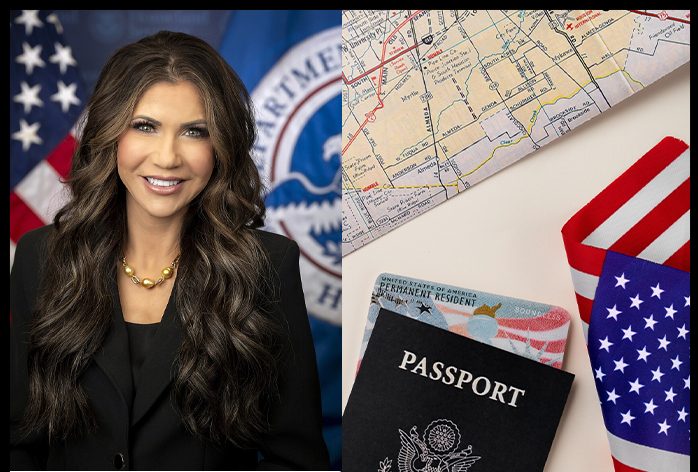
Homeland Security Secretary Kristi Noem announced a major update to U.S. travel rules on Thursday, confirming that the list of restricted countries has now grown to more than 30 nations. The decision aims to strengthen national security and improve screening standards.
Travel Ban Broadens After Earlier White House Order
The expansion follows a June directive signed by President Donald Trump. That order barred entry from Afghanistan, Burma, Chad, the Republic of the Congo, Equatorial Guinea, Eritrea, Haiti, Iran, Libya, Somalia, Sudan and Yemen. At the time, the administration said those nations lacked reliable security systems and posed higher terrorism risks.
However, Noem said the list has grown sharply.
“I can’t share the exact number, but it’s above 30,” she said on The Ingraham Angle. “If a government cannot verify its own travelers or maintain stability, we must protect the United States.”
Administration Evaluates More Countries
Furthermore, a previous Reuters report noted that officials were reviewing travel standards for more than 36 additional countries. The goal is to encourage better cooperation between governments and to ensure that visitors from high-risk areas meet U.S. security requirements.
Recent Incidents Influence Policy Direction
According to officials, recent violent attacks pushed the administration to reconsider existing rules. In one case, police arrested Mohamed Sabry Soliman in Boulder, Colorado, after he allegedly targeted a pro-Israel gathering.
Only days earlier, authorities in Washington, D.C., arrested 31-year-old Elias Rodriguez. Investigators say he fatally shot Israeli Embassy employees Yaron Lischinsky and Sarah Milgrim before officers detained him.
These incidents increased pressure on federal agencies to tighten screening procedures.
DHS Yet to Issue Full Statement
The Department of Homeland Security did not immediately respond to questions about the expanded restrictions. More details are expected once the administration completes its country-by-country evaluation.
About The Author