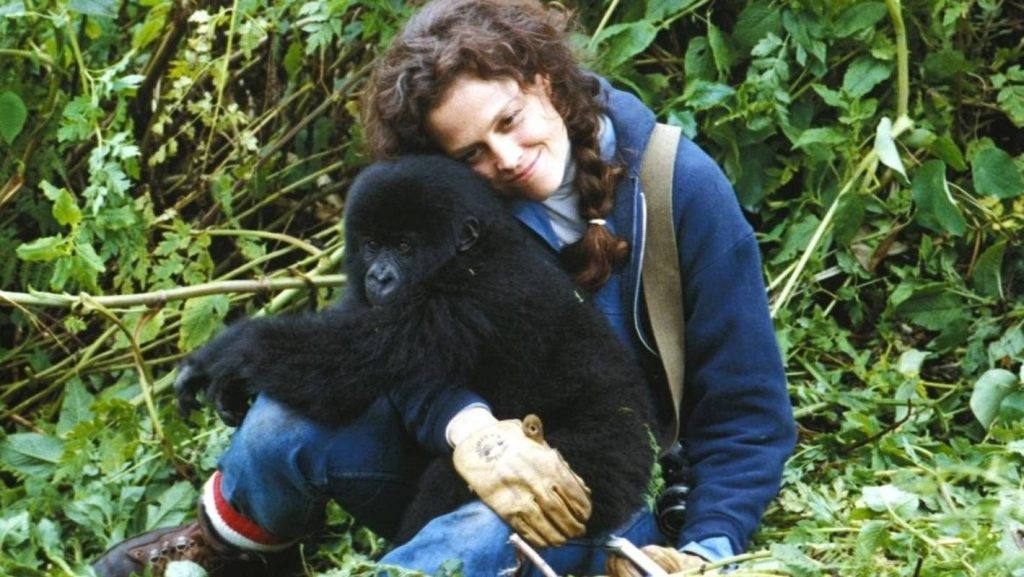
Forty years after her death, the mystery surrounding Dian Fossey’s murder remains one of the most haunting stories in conservation history. Fossey wasn’t just a researcher — she became the fierce protector of mountain gorillas, a role that earned her global praise and dangerous enemies.
A Woman Unlikely to Become a Gorilla Expert
Fossey didn’t come from a scientific background. She was an occupational therapist with chronic lung disease and a fear of heights — hardly ideal for life on steep volcanic mountains. Yet her devotion to animals pushed her to Rwanda in 1967, where she founded the Karisoke Research Center.
There, she discovered a species on the verge of disappearing. Poaching, habitat loss, and illegal wildlife trade were destroying mountain gorilla populations. Fossey made it her mission to keep them alive.
Learning to Communicate With Gorillas
To understand the gorillas, Fossey had to win their trust. She copied their movements, ate what they ate, and even knuckle-walked to appear less threatening. She learned their “contentment sounds,” avoided eye contact when necessary, and stayed lower than them to show respect.
Over time, these wild animals began accepting her presence. Her work shattered the long-held image of gorillas as violent creatures. She proved they were gentle, intelligent, and deeply social.
Her breakthrough reached the world in 1979 when David Attenborough filmed the now-legendary gorilla sequence in Life on Earth, made possible only because of Fossey’s years of patient habituation.
Digit’s Death Changed Everything
Fossey’s research took a dark turn in 1977 when her favorite silverback, Digit, was killed by poachers. His mutilated body devastated her. After that, she shifted from researcher to warrior.
Fossey began tracking poachers, seizing their traps, and confronting anyone who threatened the gorillas. Rumors grew around her methods — some called her extreme, others saw her as a guardian fighting a lonely battle. What is certain is that her anti-poaching efforts disrupted illegal trade and infuriated those who profited from it.
Growing Conflicts and Dangerous Enemies
Fossey opposed gorilla tourism and clashed with conservation groups that saw tourism as a long-term strategy to protect the species. She didn’t trust government officials, and many people involved in poaching or corruption viewed her as a serious threat.
By the time her book Gorillas in the Mist became a bestseller, she had become one of the most controversial — and admired — figures in wildlife conservation.
A Brutal Death in the Mountains
On December 26, 1985, Fossey was found murdered in her cabin at Karisoke. She had been attacked with a machete. The crime scene suggested a targeted killing, not a robbery.
A Rwandan court later convicted her American assistant Wayne McGuire in absentia, though he fled and insisted on his innocence. Another staff member accused in the case reportedly died in jail. Many conservationists doubted either man was the real killer.
Those who worked with her believed the explanation was far more chilling:
Fossey was standing in the way of powerful people making money from poaching, smuggling, and land exploitation.
Some researchers felt she had uncovered illegal activities carried out by individuals with influence. Others believed her escalating battles with poachers made her a target.
To this day, the identity of her killer remains unknown.
A Legacy Carved Into the Mist
Dian Fossey was buried in the cemetery she created for the gorillas she lost, right beside Digit. Her gravestone reads: “No one loved gorillas more.”
Her legacy is undeniable. Thanks to the awareness she sparked — and the conservation movement that followed — the mountain gorilla population is slowly growing rather than falling into extinction.
Fossey’s story is not just about science or tragedy. It is about a woman who refused to look away, who fought until her last breath to protect a species that had no voice.
And her murder, still unsolved, continues to cast a long shadow over the mist-covered mountains she loved so fiercely.
About The Author