Once a central focus of U.S. counter-terrorism efforts, a neo-Nazi extremist network is quietly re-emerging as federal priorities appear to shift.
The group, known as The Base, slipped out of public view after a major crackdown in 2020. However, it never fully dissolved. Instead, recent online activity points to continued operations across several U.S. regions, while the organization simultaneously pushes deeper into Europe.
At the center of this effort is Rinaldo Nazzaro, a former Pentagon contractor accused by analysts of ties to Russian intelligence. Under his leadership, the group adjusted its strategy. Rather than seeking attention, it now favors smaller cells and encrypted communication, allowing it to operate with less visibility.
Training in Plain Sight
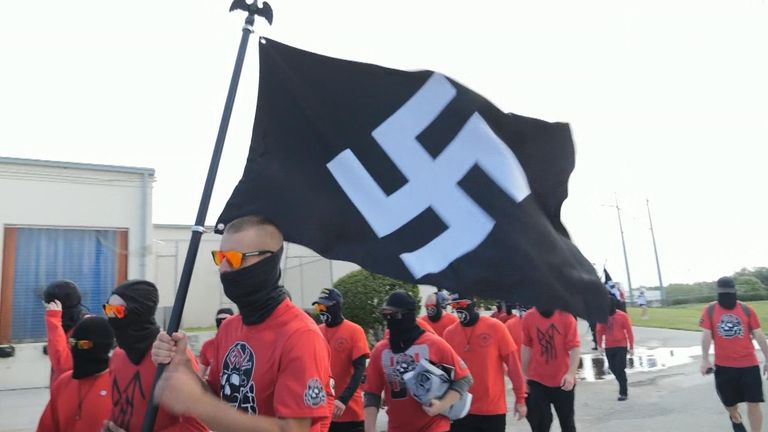
Meanwhile, new images and videos circulating online show masked men training with military-style rifles. The footage, reportedly filmed in rural areas of Appalachia, the Midwest, and the mid-Atlantic, suggests organized preparation rather than isolated activity. In several cases, members pose with the group’s black flag, reinforcing signs of coordination.
Expansion Beyond U.S. Borders
At the same time, the group’s overseas operations have become harder to ignore. Spanish authorities recently dismantled an armed cell, and investigators have linked the group’s Ukrainian branch to multiple violent attacks. Notably, that wing has claimed responsibility for a high-profile assassination in Kyiv earlier this year.
According to analysts, these developments reflect growth rather than decline. Researchers at the Institute for Strategic Dialogue say recruitment never stopped, even after earlier law-enforcement pressure. Instead, the group continues to rely on Russian-based communication channels to sustain its network.
A Shift in Rhetoric — and Risk
More recently, Nazzaro escalated his messaging. In an audio recording released on a Russian-controlled platform, he openly described long-term ambitions that include armed insurgency and territorial control. He specifically identified the United States and Ukraine as favorable environments, pointing to weapons access, terrain, and political instability.
Researchers see this language as a turning point. Whereas earlier messaging leaned heavily on ideology, current statements now outline tactics, including infrastructure attacks and sustained efforts to destabilize governments.
Enforcement Gaps and International Response
These developments unfold as the FBI, under Director Kash Patel, has reportedly redirected resources away from far-right extremism. Critics argue that this shift downplays what remains one of the most persistent domestic terror threats.
By contrast, European authorities have moved in the opposite direction. Law-enforcement agencies across several countries have coordinated arrests, while Europol has expanded cross-border cooperation. The European Union has also designated the group a terrorist organization, placing it alongside al-Qaida and Islamic State.
Waiting for an Opening
As a result, security officials increasingly view the group as a transnational threat rather than a fringe American movement. Suspected links to Russian sabotage operations have only heightened concern among European intelligence services.
Ironically, analysts suggest Nazzaro’s increasingly explicit calls for violence may draw renewed scrutiny in the United States. By outlining operational goals so openly, he may have narrowed the group’s ability to remain unnoticed.
For now, however, the network appears to be exploiting a moment of reduced domestic pressure, quietly organizing, training online, and waiting for what it believes will be the right opportunity.
About The Author