President Donald Trump has announced a plan to build a new class of U.S. Navy battleships, dubbed the Trump-class, promising unmatched firepower and unprecedented size. Speaking from Mar-a-Lago, Trump criticized past shipbuilding delays and pledged to ramp up production of advanced naval vessels.
“We make the greatest equipment in the world, by far. But we don’t produce them fast enough,” Trump said, adding he would meet with top contractors soon to accelerate construction.
A Bold Naval Vision
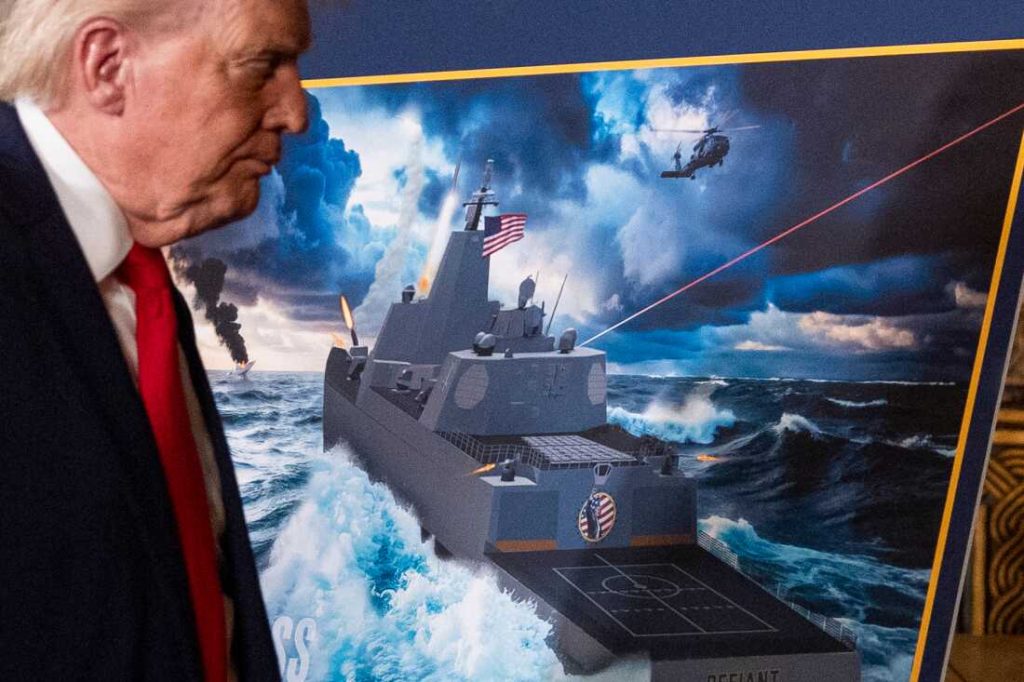
The Trump-class battleships are set to be the largest surface warships since World War II, measuring up to 880 feet long and displacing 30,000–40,000 tons. They will far outsize today’s Zumwalt-class destroyers, which weigh 15,000 tons.
The ships are planned to carry hypersonic nuclear-capable missiles, 128 vertical launch cells for cruise missiles and interceptors, conventional guns, lasers, and even a rail gun. Trump claims the vessels could be 100 times more powerful than WWII-era battleships, combining advanced weaponry with massive destructive potential.
Hurdles Ahead
Despite the vision, the program faces major obstacles. Recent U.S. naval shipbuilding has struggled with delays, cost overruns, and workforce shortages. The Constellation-class frigate program was canceled after falling three years behind schedule, and the USS John F. Kennedy aircraft carrier remains two years late.
Building Trump-class battleships will require expanded shipyards, skilled labor, and massive investment, with each ship potentially costing up to $15 billion. Analysts warn that recruiting engineers, electricians, and other specialized workers will be a significant challenge.
Modern Threats Challenge Traditional Battleships
Experts also question whether large, heavily armed vessels are suitable for today’s naval battlefield. China’s DF-26 missiles and advanced unmanned aerial and underwater systems pose serious risks, while smaller, dispersed ships may offer more tactical flexibility.
“Large platforms concentrate firepower but also concentrate risk,” said Yu Jihoon, a defense analyst. “Dispersed, smaller vessels can survive modern conflicts more effectively.”
Allies and Innovation Are Key
Trump compared the plan to JFK’s Apollo program, highlighting America’s ability to achieve ambitious goals. Analysts stress that allied cooperation, particularly with South Korea’s Hanwha Ocean investment in Philly Shipyard, will be critical to meet construction and technical demands.
“The Chinese navy is growing, and we need partners to maintain access to the Western Pacific,” said Carl Schuster, former U.S. Navy captain.
The Bottom Line
The Trump-class battleships represent a visionary but challenging effort to transform U.S. naval power. Success will depend on funding, workforce, shipyard capacity, and international collaboration. Whether the Golden Fleet becomes reality or remains a bold concept is a question the Navy will face in the coming years.
About The Author