For most of her career, Susie Wiles preferred influence over attention. Headlines never mattered as much as results, and that focus helped her become one of Washington’s most effective behind-the-scenes operators. The strategy worked for decades, quietly shaping campaigns and guiding politicians without drawing the spotlight. Until recently, few outside political circles knew her name.
A major magazine profile changed that. Suddenly, Wiles became the subject of public debate. Almost immediately, questions arose in Washington about her motives and judgment. Was the exposure accidental, or a deliberate signal?
In the article, Wiles offered rare candor. She described President Donald Trump as someone driven by vengeance. At the same time, she criticized Vice President JD Vance and questioned Elon Musk’s influence in government decisions. Each remark drew attention and sparked debate about her role in the administration.
The White House reacted quickly. Wiles insisted her words were taken out of context. Trump and senior officials publicly defended her. Even so, speculation continued to grow. Over time, it intensified rather than diminished.
A Career Behind the Curtain
Wiles has long avoided the spotlight. As the daughter of legendary broadcaster Pat Summerall, she entered politics early and quickly learned the value of discretion. Her early career included stints with Ronald Reagan and Dan Quayle. Later, Florida politics became her proving ground, a place where her skills in strategy and organization were honed.
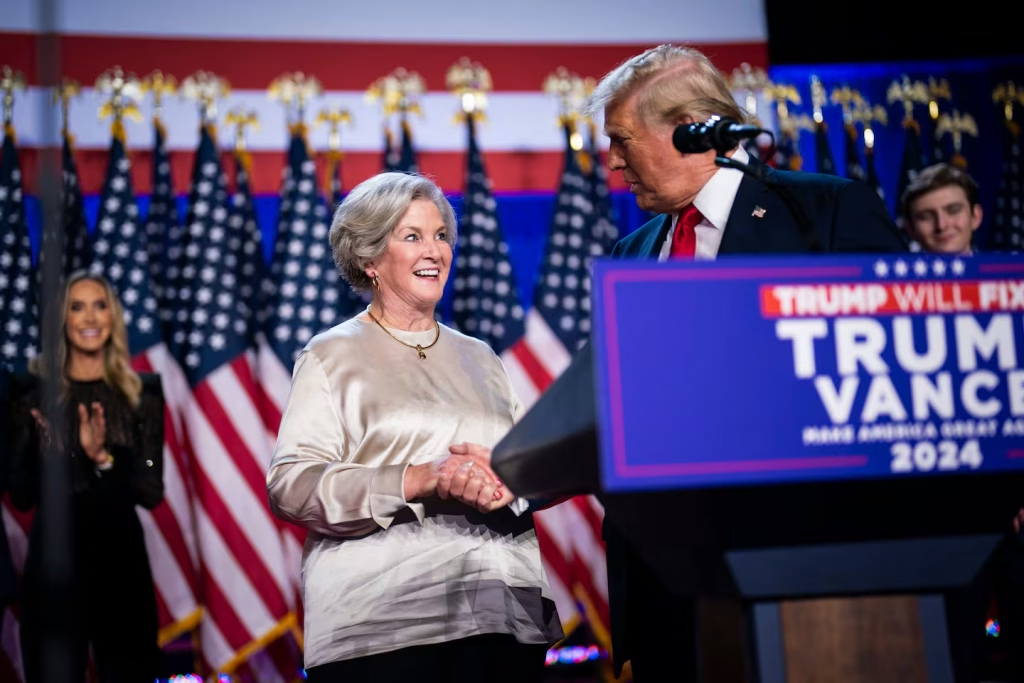
Colleagues describe her as private and disciplined. Public speaking was never her goal, while strategy always took precedence. Even after Trump’s 2024 election victory, she refused to take the microphone, reinforcing her reputation as a background operator. Despite her low profile, her influence remained undeniable. Wiles helped secure Florida in 2016 and co-led Trump’s 2024 campaign, bringing structure to a chaotic operation that had frustrated previous administrations.
Because of this history, her openness in the profile surprised many observers.
Calculated Distance or Plain Honesty?
Some political strategists argue her remarks were deliberate. Experienced operatives rarely speak candidly without purpose. Allowing criticism to appear in public may have been a way to manage her legacy and draw subtle boundaries. After all, being close to power carries long-term consequences.
Others view it differently. They say Wiles simply spoke as she always does—directly, bluntly, without filtering her observations. The only difference this time was the audience, which made her private voice public. Regardless of motive, the perception shifted. Washington rarely leaves a quiet operator unchanged after exposure.
Order Comes at a Cost
As chief of staff, Wiles holds immense authority. She manages rival factions, controls access to the Oval Office, and ensures that the White House functions efficiently. By many accounts, she has succeeded in these tasks. Operations are smoother than during Trump’s first term, messaging is more disciplined, and internal chaos has decreased.
Still, critics question her record. Sweeping federal firings, aggressive immigration enforcement, and expanded executive authority all occurred under her watch. For some, competence alone does not absolve responsibility. Efficiency can enable outcomes, and silence can legitimize decisions.
An Ending Still Being Written
Wiles rejects the label of enabler and insists history will judge her fairly. One fact remains unavoidable: her anonymity is gone. Once invisible, she is now scrutinized. Whether she remains in the White House long-term is uncertain. What is clear is that Susie Wiles can no longer operate quietly, and in politics, visibility changes everything.
About The Author